
The Welcome is a scene which appeared in a draft of The Gift of Belonging (Book 3 in The Wise Women series, out May 2026). Sadly, it didn’t survive the cut. It’s based on real history, from the time Lydney Town Hall in the Forest of Dean, UK, was used as a Red Cross Auxiliary Hospital in WW1.
My protagonist, Rose, is a VAD (Voluntary Auxiliary Defence Forces) nurse during the war.
The train whistle screeches, steam plumes above and to the sides of the train, and Lydney Town Station platform slides into view. Rose stares. Dozens of men and women mill about, dressed in coats, hats, gloves and scarves to keep the cold at bay. Surely they aren’t all travelling on from here? There is no luggage at their many feet.
Carriage doors are pushed open along the train, and as Rose does the same and emerges, she quickly understands what is happening. She has unknowingly travelled with dozens of wounded and recuperating soldiers, likely from Cheltenham Hospital and destined for the Red Cross hospital where Rose volunteers. The crowd on the platform are here to welcome the soldiers and offer help where it’s needed.
Several stretchers are carried from the train onto the platform, and Mr Birt, the town’s transport officer, organises men to carry them and their occupants the short uphill distance to the town hall.
Rose smiles at the middle-aged stretcher-bearers’ eagerness. She casts around to see if she can assist somewhere, and walks towards a young soldier with one eye bandaged. The soldier’s other eye squints in the dazzling light.
‘I’m a volunteer at the hospital,’ she tells him. ‘Can I help you find your way? It’s not far, and straightforward, but we don’t want you stumbling into a horse and wagon.’ She says it lightly, and the soldier grins, peering at her with his one bedazzled eye.
‘Thank you,’ he says. His accent is Welsh. ‘I’d like that.’
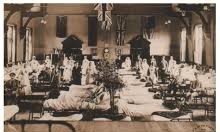
Rose and her patient sidle through the dispersing crowd, out of the station, and turn left to walk up Hill St with other walking wounded and their attendants, past the Feathers Inn, past the medieval cross and into the town hall. The main hall, the four rows of close-set beds with their white sheets and pillows, grey blankets folded at the ends, are hidden beneath a mass of men and volunteers as the latter settle the new arrivals. The big room is warm from the clanking radiators, filled with light from the large windows, and buzzing with conversation in all accents of the British Isles.
Thanks to The Forest at War published by the FoD Local History Society for the information about the welcoming crowd and Mr Birt.
Find out more about The Wise Women series and The Gift of Belonging here.