Self-publishing for beginners is a very abbreviated version of the most important things I’ve learned in my self-publishing journey over the last several years.
This post contains the slides and notes I prepared for a one and half hour workshop I delivered in April 2026. That’s not a long time for such a complex topic, with rabbit holes galore! In order not to terrify my audience of total beginners, I thought about what I wished I’d known at the beginning, and took it from there. I hope you find Self-publishing for beginners useful too.
Definitions
Let’s start with what we mean by self-publishing with the help of the explanations below.
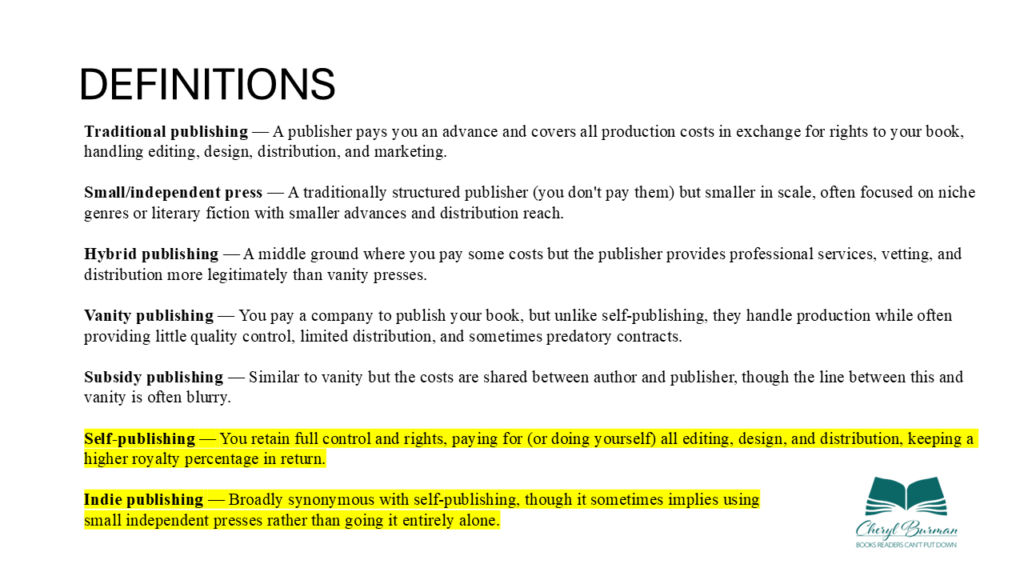
Essentially, self or indie publishing means you’re responsible for all aspects of your book, from writing it to getting it into people’s hands. You can contract out some of these aspects – editing, covers, formatting, for example – but you’re in control.
One thing: beware of vanity and subsidy publishers. They’ll take your money and do very little in return – poor if any editing, a ghastly cover, and throw it up on Amazon. Don’t do it!
What’s your goal?
If you simply have a burning desire to tell that one story, eg a family history, and sell/give it to those who will be interested, then get the book edited, nicely formatted with a good cover, have some copies printed either privately or through Amazon, put it on Amazon (in case someone does buy it!) and job done.
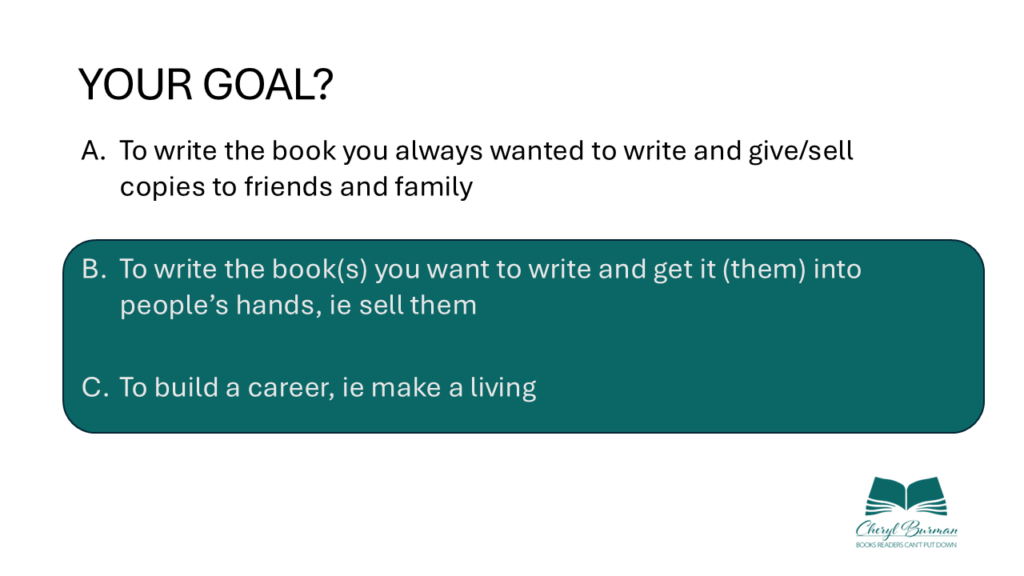
If C. is your goal then my strong recommendation is to write in commercially successful genres, eg contemporary romance, historical romance, mystery, crime and psych thrillers, cosy mystery – see below.
But for either B or C, the advice here is appropriate.
The key things to think about
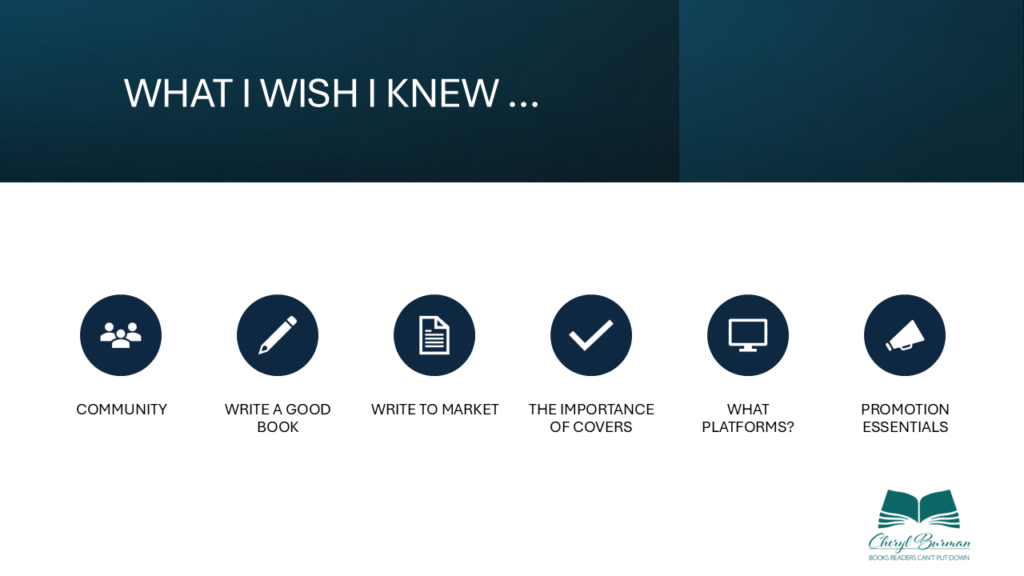
I’ve grouped the ‘what I wish I knew’ into six areas. Note that four of the six are to do with the book itself, because if you don’t get that right there’s no point doing the rest – a poorly written and edited book is unlikely to sell beyond your most loyal friends and your mum.
Community
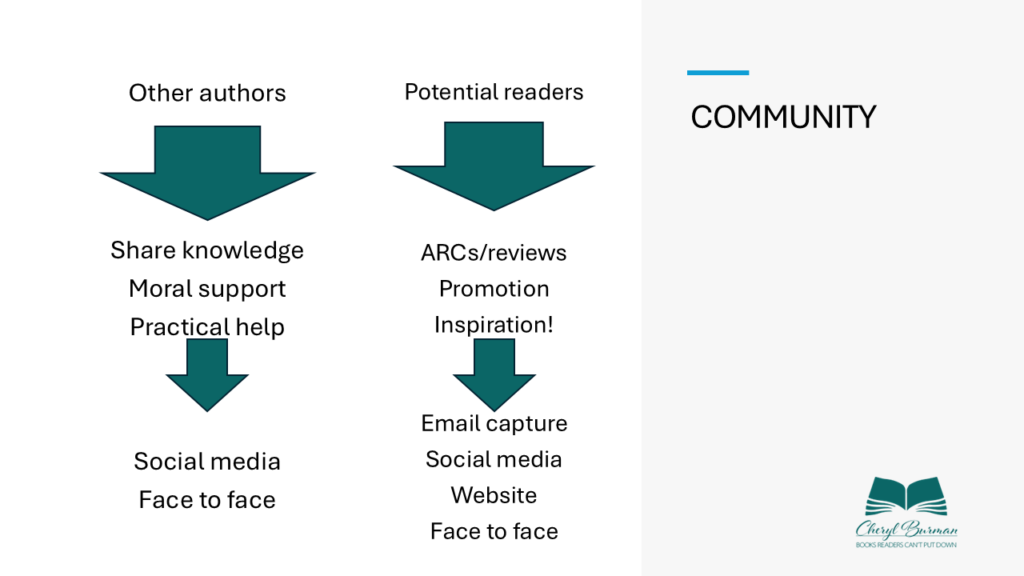
Start building community before you publish that first book – get the word out there! And then keep going.
Authors
Writing need not and should not be the lonely practice it’s often portrayed as being. Build friendships with other authors (I mean writers who are also interested in publishing and selling). They will give you practical help and advice on all manner of things, for example as critique partners (sharing your draft as it goes along and getting feedback); as beta readers (reviewing your final draft); ARCs (Ahead Review Copy reviewers to get those ratings and reviews up); and helping to promote your book. Give more than you take is a good guide!
Find your author community through a local writing group, but more likely online. I found mine through Twitter, and now have an online Zoom group, but you can find community on Facebook and other social media too. Look for other authors whose work you like and reach out – not via direct messaging initially! Build the friendship first.
Potential Readers
More on this on promotion, but there’s no substitute for getting out there and talking about your book. People can’t buy what they don’t know exists. Use social media but don’t fill your page with my book, my book, my book…. Face to face is highly effective, so offer at book clubs, library talks, etc – become a speaker! Capture fans’ emails for newsletters – more on that later – and/or build the group on social media.
Write a good book
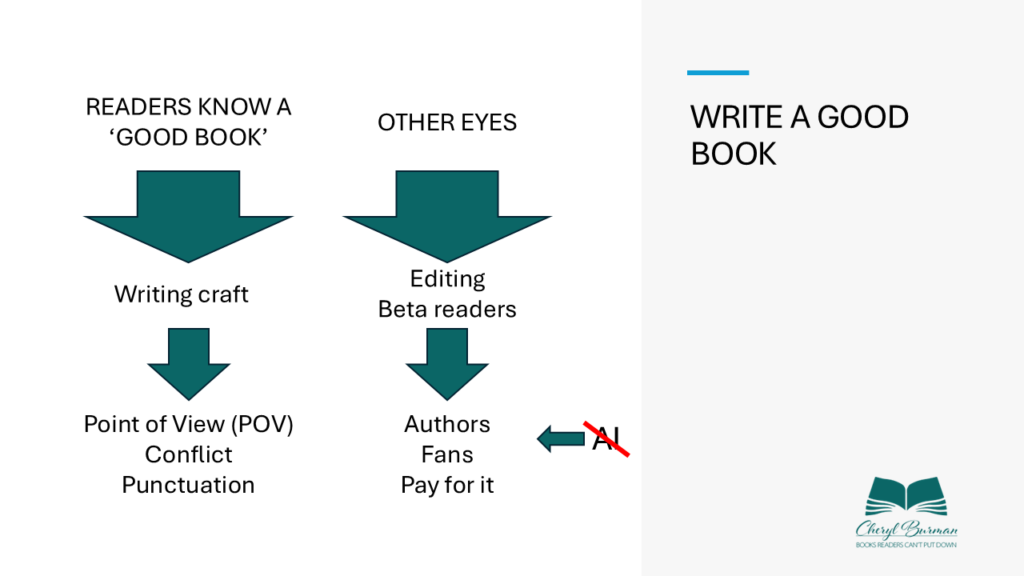
And I mean A GOOD BOOK, not what you think is good, but what readers think is good.
Readers know a ‘good book’
Focus on characters, action, pacing, plot – this is all craft and you can learn it for yourself – see resources. We all have to learn – it’s not a case of simply writing down the story in your head, sorry.
The thing I wish I’d known was Point of View – one character’s voice at a time – the easiest way to achieve compelling characters.
And while readers aren’t super fussy about grammar and Oxford commas, please make sure your typos are minimal and your punctuation – esp dialogue – is correct. (Bandwagon!)
Read widely, and especially best sellers in your genre. It can ruin the book for you as you become more aware of what makes and doesn’t make good writing, but you learn a lot!
Other eyes
An editor is a good investment – not just for typos (that’s a proof reader not an editor), but to help you learn the craft. Where your author community comes in handy, at least those who are good writers, as critique partners and beta readers.
Beta readers should, in the main, be plain old readers.
See list of blog posts at the end for more about beta readers.
NEVER UPLOAD YOUR BOOK OR ANY SIGNIFICANT LENGTH TEXT INTO AI. 1. It steals, and 2. your book could be branded as AI and that’s not good.
Write to market
If your aim is to make a living from writing, then writing to market is the most effective way of getting there. That is, write in popular commercial genres, as below (where romance dominates).
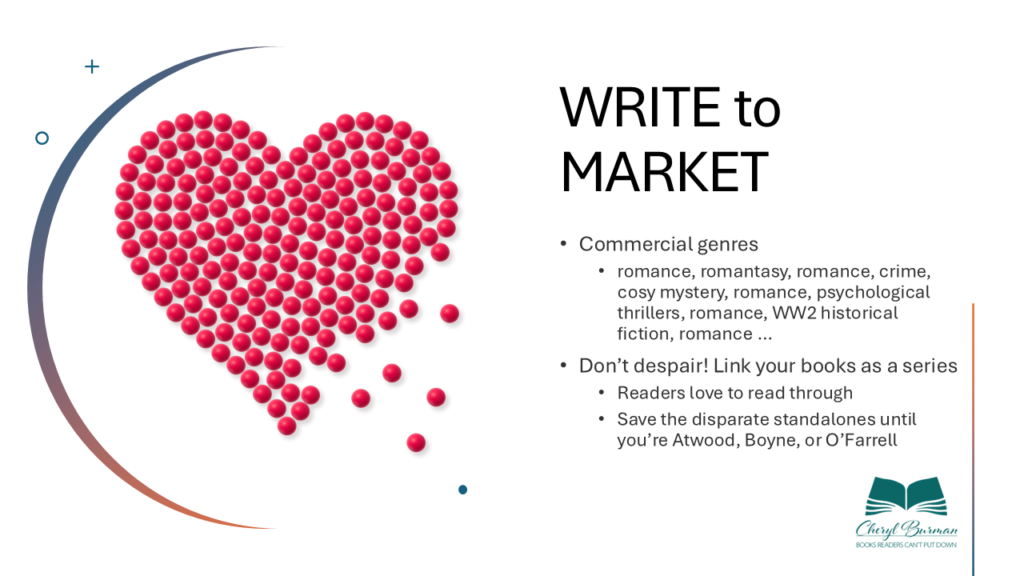
But don’t despair if you want to write what you want to write! Create a series, writing additional stories in the same world as your original book, keeping old and adding new characters. Readers mostly love a series, and that’s where you will get income. It’s what I did with Keepers and River Witch, neither of which were meant to be series.
The importance of covers
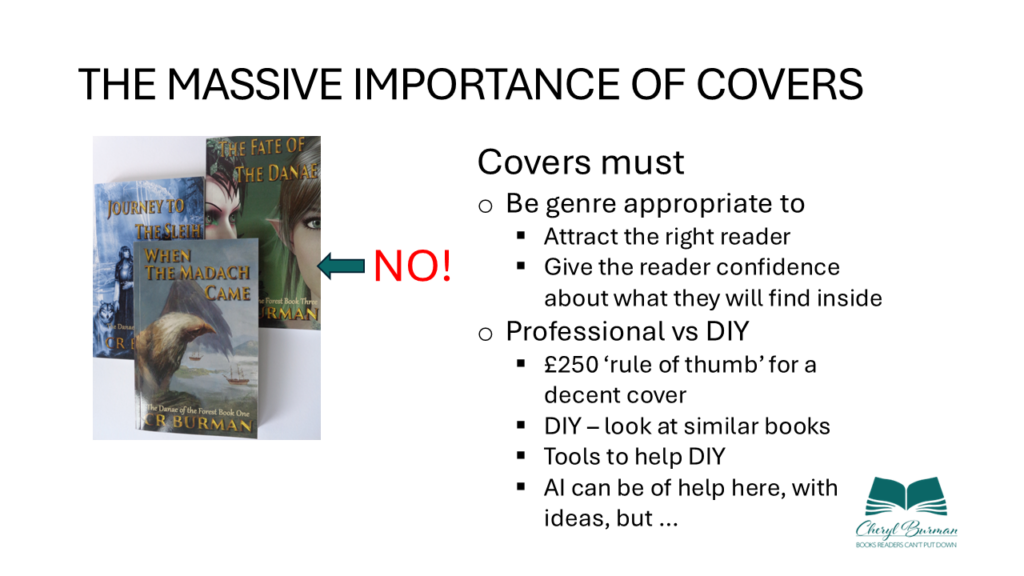
Readers do judge a book by its cover. Plain fact!
Genre is key
The key thing here is to look at other covers in your genre, and aim for the same vibe. If you can afford a professional graphic artist, fantastic!
If you or someone you know has professional tools like PhotoShop and InDesign, beg them to help/do! At a more basic level, BookBrush (which is exclusively for authors) has cover templates which are 100% adjustable, and Canva is a popular tool with authors. Images come from free and paid sources, and ensure you understand copyright and paying. AI can be useful to generate ideas, and you might get lucky with something usable. But you don’t want your cover to look AI gen (unless you’re writing Victorian orphan/seduced maid novels, which do very well, thank you).
The covers in the image were my original ones for what is now The Guardians of the Forest series, my middle grade fantasy books. They’re a lot more on genre these days!
What platforms?
Where do you sell and display your books?
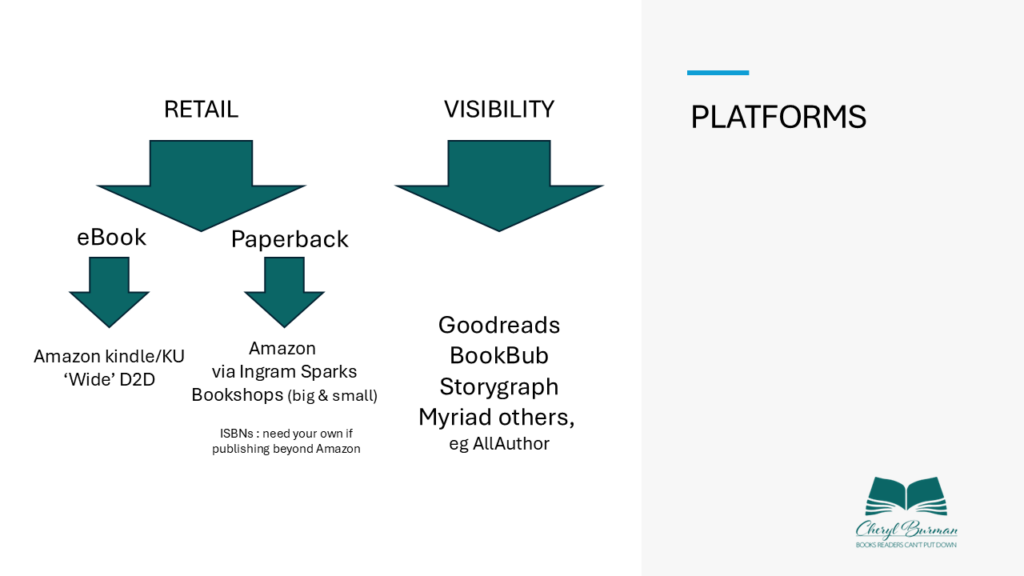
Retail platforms
Ebook you have to decide if you think your book will suit Kindle Unlimited readers – commercial genres, yes, and my own women’s historical fiction and historical fantasy have done well there. Mostly in the US – KU is not so big in the UK.
If in KU, then you need to be Amazon exclusive. D2D (Draft2Digital) is the other major platform which will upload your eBook to Kobo, B&N, Googleplay, Apple etc etc. Amazon is free. D2D no longer is – a $20 set up and $12 pa if you sell less than $100 pa.
Paperback – No exclusivity here and many authors upload to Ingram Sparkes as well – many advantages in that it’s easier to get into bookstores eg Waterstones and independents, libraries, and international as well. I haven’t done it, although I wish I had for the bookstore option, but IS is not straightforward to use.
You will need your own ISBN if you’re going to publish outside Amazon. Extended distribution on Amazon helps but some stores (eg Waterstones I think) don’t recognise it, and it can make your paperback expensive.
Ask your local bookstore to stock it (own ISBN or not) – some will, some won’t, and generally on a sale or return basis. If the book has a local theme/setting promote that in the blurb.
Audiobooks – not shown on the slide. If you can afford it, do it! You might not get your money back though. Amazon has a digital option which is free for some books – they offer it to you – and I’ve done this with Keepers. It’s not bad.
Visibility
These are platforms which link to retail ones (mostly Amazon), and include GoodReads, Storygraph, and BookBub. There’s an automatic upload to Goodreads once the book is on Amazon, so check the listing to make sure it’s under YOUR name. (Goodreads Librarians FB group for help – see links). Storygraph – again check, as a reader might have uploaded the book, minus its cover perhaps! You can edit this.
Bookbub – easy and free. When you set up your account, say you’re in the US even if you’re not, as that gives you a wider range of options. BB also alerts your followers when you have a new release.
Throw it up on anything that’s free, eg AllAuthor, Independent Author’s Network – you never know!
Promotion essentials
This is the hardest and longest part of the book journey, and where consistency and perseverance really count! A workshop on its own, but here are some key pointers to get you started.
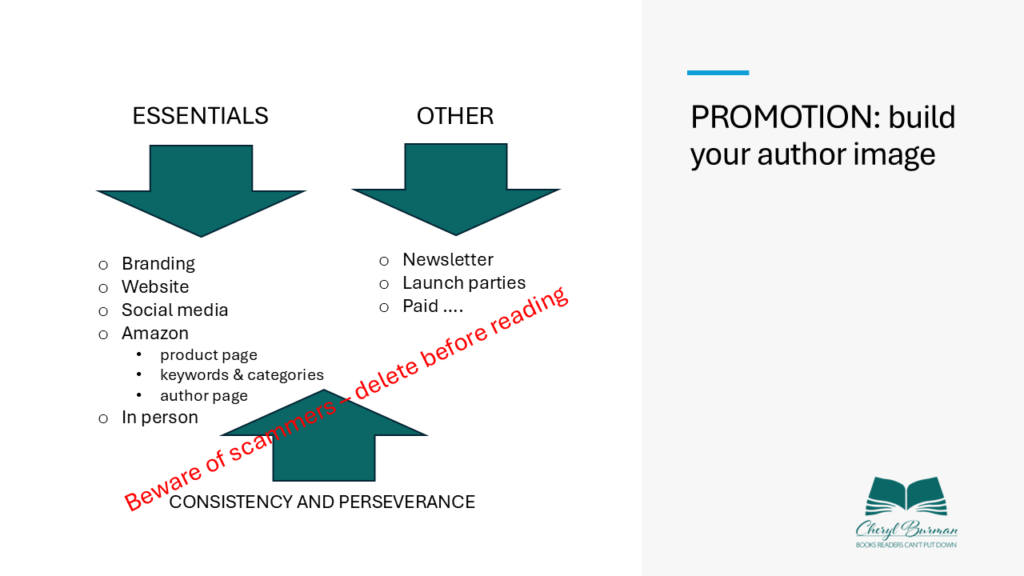
Essentials
The world wants to ‘help’ you promote your book. Delete and ignore all such emails.
Branding: this underpins everything Easier if you write in one genre, but at least consistency within each genre. This is colours, fonts, ‘look’ – use for website, social media headers, bookmarks, banners etc.
Website: this is your author home, the place where people can meet you as a person, find all your books etc. WordPress and Wix are popular. Look at other author sites and take from them what you like, and also what suits your books. Keep it up to date.
Social media: Set up an author page where you can legitimately talk about your book – and other writing related topics. Use your FB profile sparingly for this. Some authors set up book club pages to build a community of like-minded readers. Pick ONE that best matches what you write/you’re comfortable with. The aim is to be a human presence, not grow 20k followers. It’s not there ONLY to promote your books. Here’s some feedback from a book retailer – her best sellers are all from authors active on SM because people recognise the covers and feel more comfortable for that reason.
Amazon product page: Cover, subtitle, book blurb (which will be copied to other platforms), Amazon A+ (although often hidden now on the phone). The blurb: short, white space, a marketing tool not a book summary.
Keywords and categories: choose carefully, don’t be misleading.
Fill in your author page: Amazon lets followers know when you have a new book out.
In person: library etc talks, book fairs, book clubs. Focus locally initially.
Other
Newsletter: still considered an essential by the gurus, but personally I think they have passed their usefulness, based on my own experience. Good if you can get to thousands on your list, as then it’s a numbers game, but my theory is that you get to that by being a best seller not the other way around. Which makes on-selling easier, of course.
Launch parties: an opportunity to do that in-person selling, also book signings say at your local bookshop or perhaps the library.
Paid: from one off newsletter promos such as Fussy Librarian to advertising on Facebook, Amazon, BookBub – it’s all out there. Don’t spend your money until you have at least three books in a series because read through is the only way to profitability. And again, commercial genres will do better.
Links and tools
Links and tools
Websites – try to avoid free ones, get your own domain name. Prices vary across the board.
WordPress https://wordpress.com/sites
Wix https://www.wix.com/
Retail sites
Amazon KDP https://kdp.amazon.com/
Draft2Digital https://draft2digital.com/
Ingram Sparks https://www.ingramspark.com/
ISBNs (UK only) https://www.nielsenisbnstore.com/Home/ISBN
Covers
Miblart https://miblart.com/services/book-cover-design/
More Visual https://bookartwork.com/
Fiver (but be wary)
Images (beware of copyright!) : free and paid: Pixabay https://pixabay.com/; Adobe Stock https://stock.adobe.com/uk/illustrations; Dreamstime https://www.dreamstime.com/;
For others, google royalty free images UK
I need a Goodreads Librarian: https://www.facebook.com/groups/371827783200870
Tools
•BookBrush https://bookbrush.com/ (a very limited free, but recommend the basic at USD99 pa)
•Canva https://www.canva.com/en_gb/ (free + paid)
•MailerLite https://www.mailerlite.com (min $18 pm for <500 subscribers)
•Mailchimp https://mailchimp.com/ (min £10 pm for <500 subscribers)
Sign up to these gurus
•Jane Friedman https://janefriedman.com/ (free + paid)
•Dave@Kindlepreneur https://kindlepreneur.com/ (free newsletter and a range of ‘freebies’. )
•Matt Holmes https://www.matthewjholmes.com/ (a basic free course and newsletter, then costs for ad courses)
•Dave Gaughran https://davidgaughran.com/ (all free)
Writing resources
Some from my own experience and site which expand on topics mentioned here.
Reference books
There are hundreds out there, ask around for what others have found useful. I’m not a big fan of prescriptive Five Acts, Six Acts etc, because the essence to any story is – set your hero a goal, overload him with problems, have him sink into despair, and then emerge triumphant … That’s it! Memoir may be different! These two books are more about craft.
Self-editing for Fiction authors Renni Browne and Dave King
How not to write a good novel Sandra Newman and Howard Mittelmark
Blog posts
Beta readers https://cherylburman.com/beta-readers-what-are-they-and-why-do-you-need-them/
Blurbs https://cherylburman.com/six-dos-and-four-donts-in-writing-book-blurbs/
Dialogue https://cherylburman.com/four-steps-to-using-dialogue-to-drive-your-story/
POV https://cherylburman.com/multiple-povs/; https://cherylburman.com/using-deep-point-of-view-to-immerse-your-reader/
For more Writing Tips (use the search tool at the bottom of the category page) https://cherylburman.com/category/writingtipsforauthors/