
‘Talking Heads’ syndrome is something I’ve come across several times in work I’ve been editing. So when I was offered the opportunity to talk to a group of Year 9 students, I decided I’d get to them early!
Without telling them what the topic was, I first asked them to write (individually or with a couple of mates) a short scene of two women discussing the upcoming school holidays – no clues beyond that. They didn’t need to read it out, but we did a short quiz where they could give themselves a point for the following things they included:
- Did you show the reader where the scene took place, eg in a cafe, watching a sports game …?
- Did you show the reader what was happening around the women?
- Did you have the characters doing anything, eg drinking a cup of coffee?
- Did you mention/hint at their relationship, eg old friends, just met?
- Did you describe the characters in any way? eg dark hair, no makeup, broken fingernail?
- Did you suggest how either of them feels about the topic of the school holidays? eg, worried, excited, bored …
As we worked our way through the points below, I got them to add to their pieces, and at the end had some volunteers (well, the first one got volunteered, but then many others followed) to read their finished products and for the rest to comment what they liked about them. They did great jobs.

The presentation is linked at the bottom of this post, but here’s the wordy version.
What is Talking Heads syndrome?
Here’s a definition which Google served up which is perfectly adequate –
Talking heads syndrome occurs when dialogue dominates a scene without accompanying action, setting, or internal thought, making readers feel the characters are floating in an empty void.
What’s wrong with Talking Heads syndrome?
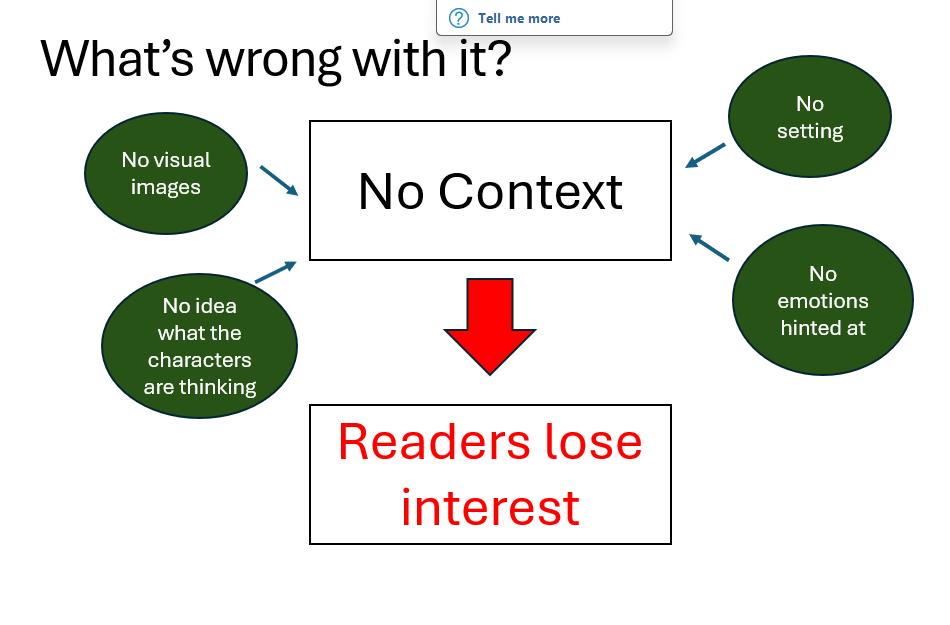
When two people are simply talking to each other, and there’s
- no setting (I’ve read scenes where you literally have no idea where the people are for the entire conversation)
- no physical activity by the characters – no gestures, eye narrowing, looking away, shrugging etc
- no inner thoughts of the Point of View character …
then the reader is left floundering. What’s the mood here? What emotions are the characters expressing through non-verbal signals? What’s going on around them, which may be relevant to the scene, or enhance the emotions. And just like that, they’ve lost interest.
How do we fix Talking Heads syndrome?
Where are they?
Put your characters in a setting, even if it’s just walking along the road. Even better is a sentence or two showing what’s happening around them, and what kind of day it is/room they’re in.

These give a reader a scene in their mind – preferably not too detailed but concrete, eg a woman pushing a pram, a hissing coffee machine. More, they can add to the atmosphere you want to create – is there a louring sky, or is the sun shining? Choose carefully – you are in charge of the weather!
Their appearance
Physical descriptions. Hair colour etc may be of interest, but what’s more interesting are descriptions which indicate the character’s general state of being, eg perfectly made up (the woman in control of her life), or unbrushed hair … (the normal woman), bags under the eyes.
Gives the reader a sense of the character’s personality, or their general state of being right now.
What are they doing?
Activity, eg fiddles with the teaspoon, pushes back her hair, waves a travel brochure, show emotions/state of mind.
What are they thinking?
Show emotions directly for the POV character through .inner monologue, especially undercurrents, what is not being said.
The combination of these additions beds the reader in the scene: they can see it, they can understand what the characters are thinking and feeling, and their reactions to each other. They can be engaged in what’s going on because it’s a richer experience.
How do we incorporate these aspects into our scene?
Through narrative description
A steamy, noisy cafe versus a bench in a quiet park sets a totally different mood for the conversation, eg
They sat at the café table, coffees steaming in front of them. An elderly man and woman sat, silent, in a corner.(visual setting)
The beat of the rain on the pavement reflected the drumming of her heartbeat (atmosphere)
Use action beats …
to break up dialogue and reinforce setting. Most importantly, to reveal state of mind eg
‘Are you happy with that?’ He tapped his spoon against the cup, a sharp staccato. (implication is that the other person is not meant to be happy)
Inner monologue
As noted above, eg
No, she wasn’t happy. She smiled brightly. ‘Yes, of course, whatever you say.’ (her real vs spoken thoughts)
The end result
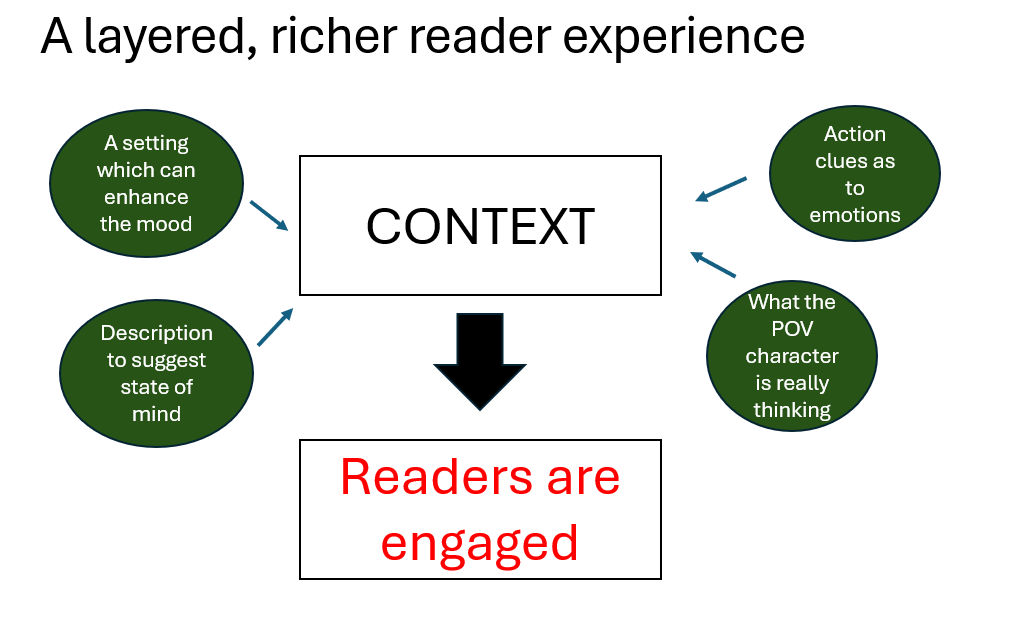
All of this builds to a layered scene which is more engaging for the reader AND conveys what the writer wants to convey more convincingly.
Summary
When writing dialogue, ensure you show the reader where the characters are and hint, or be direct, about what they’re thinking and feeling so you don’t leave your reader in the dark and losing interest.
Here’s the presentation. Feel free to share it!
For more writing tops, take a look at the blog posts HERE. There’s a search bar at the bottom if you’re looking for something specific.
For external resources on writing craft, I highly recommend that you sign up here. Jane Friedman has wonderful guest bloggers and you can learn a great deal from them.