
For some time now I’ve been meaning to do a post on symbolism in writing, but haven’t got around to it. Mostly because I don’t deliberately insert symbolism into my books, and if you asked me what was there under the tag, I would doubtless look at you blankly.
But in the new novel in the Wise Women series – set mostly in WW2 – I’m continuing the tradition which Aaron started in River Witch when he gave Hester a small calico bag containing dried feverfew, saying it would ‘give her strength’.
How it started
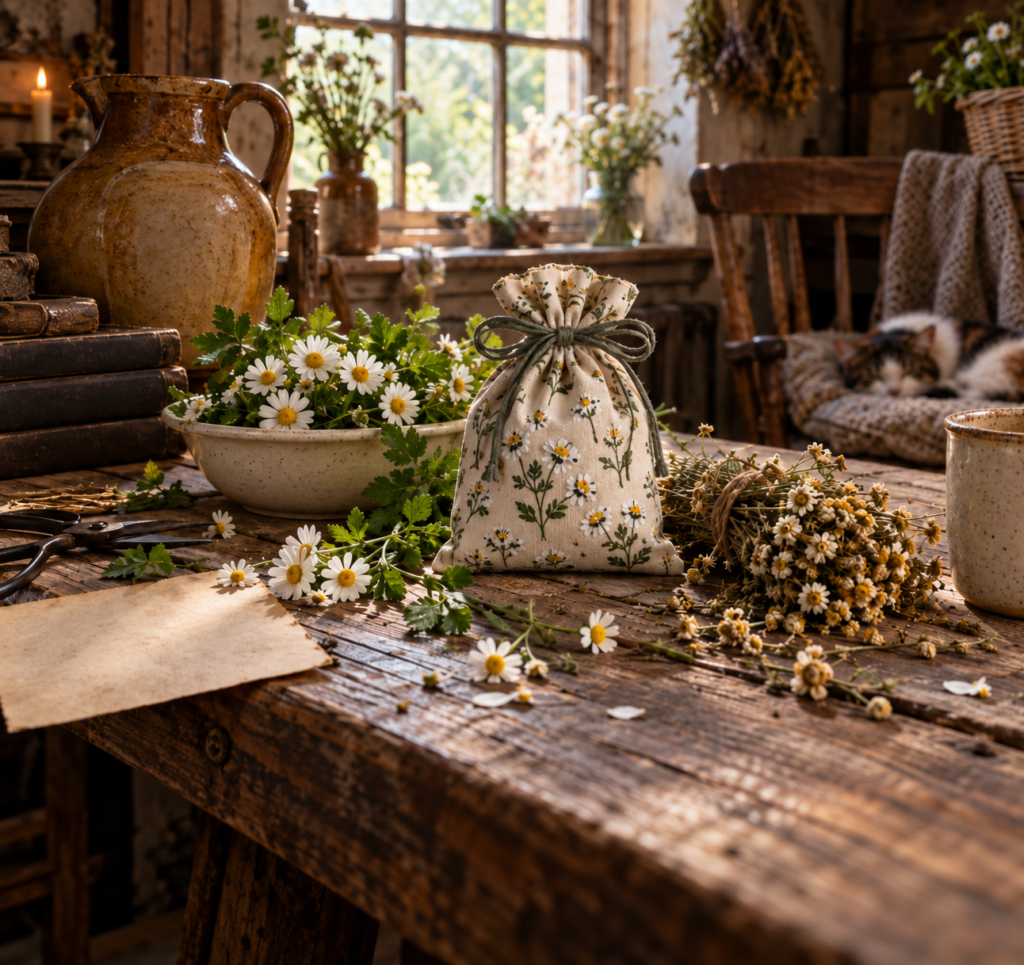
Here’s the passage from River Witch:
His [Aaron’s] fingers dance among the detritus on the table to land finally on a small muslin bag hung on a cotton thread. ‘Do you remember the feverfew we picked and dried at the beginning of summer?’
…
‘I do remember. What of this feverfew?’
‘I’ve made a gift for you from it.’ He loops the thread over her hair, commenting on how tall she has grown and she laughingly says she would have expected to grow in the past year.
‘The feverfew will protect you.’ He doesn’t say from what. ‘And make you strong.’
In The Herbalist’s Daughters, Hester makes fresh sachets of feverfew yearly for herself, Ellen and Rose, and in The Gift of Belonging, Rose wears hers under her VAD uniform. In fact, she finds a practical use for it to hide away an item very precious to her (no spoilers).
I’ve decided (in retrospect) I can claim the feverfew bag as symbolism, both because of the herb itself and the tradition of my wise women wearing it.
Protection
I chose feverfew initially because of its protective qualities. Now, digging further, I found the name comes from the Latin febrifuga, meaning to drive away fever – or, if you choose, to drive away anything which might harm you. Aaron was very aware of the dangers Hester faced in the pursuit of her dream to be a herbal healer. After all, he’d been there before when another young woman’s dreams had led to tragedy, and he was ever a reluctant mentor to Hester.
Strength
Hand in hand with this is the strength aspect. As readers of the books know, my protagonists need strength to battle prejudice, misunderstanding, loss, betrayal, and in some cases downright hatred in order to find their places in their worlds. Aaron wanted to impart what strength he could to Hester. Feverfew isn’t a big dramatic plant like mandrake, say. It’s not something you’d look at and think, strong. It’s a pretty little herb with tiny flowers and delicate serrated leaves, but also a tough perennial, bouncing back year after year. Modest looking, yet resilient, as all my heroines have to be.
A woman’s herb
Feverfew is also a herb associated specifically with women, traditionally used for menstrual problems, fertility and childbirth as well as general pain and fevers. How apt then to have the little pouch of dried feverfew handed down in a family of women where, apart from Aaron, the men largely tend to be bit players. Sorry!
Symbolism
So what do you think? Do you agree with me that Aaron’s gift to Hester, something to protect her and make her strong, is a nice example of symbolism?
You can find my Forest of Dean based Wise Women books here.
And explore more about healing and herbs in these blog posts.